Identify brain and Nerve Issues early gives you the best chance for fast, effective, and long-lasting recovery. Neurological disorders often progress silently, and many people ignore early symptoms like headaches, tingling, memory lapses, or sudden weakness. However, modern neurology has evolved rapidly. Today, advanced tests allow doctors to see changes in the brain and nerves long before they cause severe complications.
As the healthcare field grows, people look for accurate diagnosis, faster treatment planning, and personalized care. The Best Neurologist in Faridabad helps patients achieve these goals by combining clinical evaluation with advanced neuroscience tools. When these tests work together, they uncover hidden damage, detect abnormalities, and guide specialists toward the right treatment pathway.
This blog explains why these tests matter, how they work, when doctors use them, and what patients should expect. Each section uses simple language, clear transitions, and Google Semantic structure to improve readability and search performance.
Identify Brain and Nerve Issues Through Advanced Neurology Evaluation
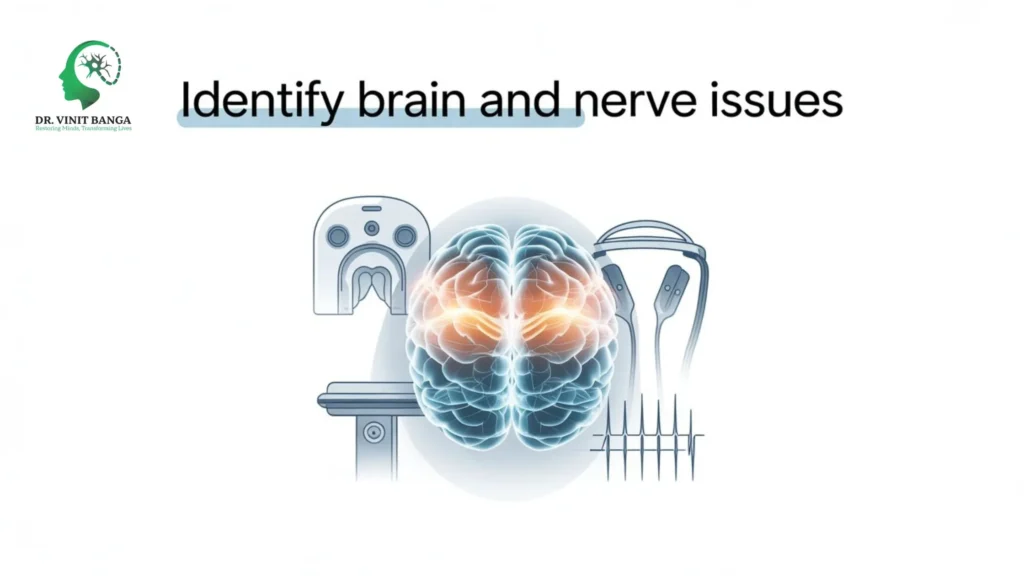
Identify Brain and Nerve Issues before symptoms grow worse. Early detection allows doctors to evaluate nerve pathways, measure brain activity, and study blood flow patterns. Modern neurology depends on a combination of test groups:
- Structural imaging tests
- Functional imaging tests
- Electrical activity tests
- Blood flow and vascular tests
- Neuropsychological evaluations
- Laboratory and genetic tests
Each group plays a unique role. Together, they explain what is happening inside the brain, spinal cord, and peripheral nerves.
Read:- https://drvinitbanga.in/stroke-in-young-adults/
Why Early Testing Helps Identify Brain and Nerve Issues Faster
Identify Brain and Nerve Issues early because neurological diseases rarely improve on their own. Conditions like epilepsy, stroke, migraines, neuropathy, dementia, and nerve compression progress silently. Early testing benefits patients in several ways:
- Detects treatable problems before permanent damage occurs
- Reveals hidden abnormalities that physical symptoms cannot show
- Helps neurologists select the most effective treatment plan
- Avoids unnecessary medications or surgeries
- Improves long-term outcomes and reduces relapse chances
Moreover, advanced tests act as a roadmap. They guide doctors from suspicion to diagnosis and from diagnosis to personalized treatment. This structured approach ensures accuracy and efficiency.
1. MRI Scan: The Gold Standard to Identify Brain and Nerve Issues
Identify Brain and Nerve Issues with MRI (Magnetic Resonance Imaging), the most detailed structural imaging tool used in neurology. MRI uses magnetic fields and radio waves to create high-resolution images of the brain and spinal cord tissues.
What MRI Detects
MRI identifies:
- Brain tumors
- Stroke (ischemic or hemorrhagic)
- Multiple sclerosis plaques
- Nerve compression
- Traumatic brain injury
- Infections and inflammations
- Brain malformations
Why MRI Is Highly Effective
- It shows even tiny lesions.
- It works without radiation.
- It captures clear images of soft tissues.
- It provides different sequences for different disease patterns.
Types of MRI That Improve Detection
- MRI Brain for general neurological evaluation
- MRI Spine for back pain, slipped disc, or nerve compression
- MR Spectroscopy to measure brain chemicals
- Functional MRI (fMRI) to study brain activity during movement, speech, or tasks
Each type offers additional layers of information that help Identify Brain and Nerve Issues with greater precision.
2. CT Scan: Fast Imaging That Supports Emergency Diagnosis
Identify Brain and Nerve Issues urgently with a CT scan when emergencies occur. CT uses X-rays to produce quick images of the brain and skull.
Why Doctors Use CT Scans
- It detects bleeding within seconds.
- It is essential for stroke emergency treatment.
- It identifies skull fractures after accidents.
- It guides immediate medical decisions.
CT Is the First Choice in Emergencies
Neurologists often choose CT when every minute matters, especially during:
- Sudden severe headache
- Loss of consciousness
- Seizures
- Road accidents
- Suspected brain hemorrhage
Although MRI offers more detail, CT provides unmatched speed in critical situations.
3. EEG: The Key Test to Identify Brain and Nerve Issues Related to Electrical Activity
Identify Brain and Nerve Issues linked to abnormal electrical activity using an EEG (Electroencephalogram). EEG measures brain wave patterns through small sensors placed on the scalp.
Conditions Detected by EEG
- Epilepsy
- Seizure disorders
- Memory disturbances
- Sleep disorders
- Brain infections
- Abnormal brain wave patterns in coma
Why EEG Matters
EEG helps neurologists understand how electrical impulses travel inside the brain. When these signals become abnormal, seizures or cognitive issues occur. EEG identifies specific patterns, triggers, and seizure types, allowing specialists to choose the right anti-epileptic medication.
4. Nerve Conduction Study (NCS) and EMG: Essential for Peripheral Nerve Issues
Identify Brain and Nerve Issues affecting the arms, legs, and peripheral nerve pathways with NCS and EMG.
NCS (Nerve Conduction Study)
NCS measures the speed and strength of signals traveling through your nerves.
It diagnoses:
- Peripheral neuropathy
- Nerve compression (carpal tunnel syndrome)
- Diabetic nerve damage
- Sciatica
- Weakness or numbness in limbs
EMG (Electromyography)
EMG checks how muscles respond to nerve signals.
It identifies:
- Muscle disorders
- Nerve root compression
- Motor neuron diseases
- Neuromuscular junction disorders
Together, They Build a Complete Picture
Doctors use both tests to understand whether the issue starts in the nerve, the muscle, or the connection between them.
5. VEP, BERA, and SSEP: Advanced Evoked Potential Tests
Identify Brain and Nerve Issues through evoked potential tests that evaluate how the brain responds to visual, auditory, and sensory signals.
Visual Evoked Potential (VEP)
- Assesses the optic nerve
- Detects early vision-related neurological diseases
- Useful in multiple sclerosis
Brainstem Evoked Response Audiometry (BERA)
- Tests hearing nerves
- Detects brainstem pathway problems
- Evaluates children with hearing issues
Somatosensory Evoked Potentials (SSEP)
- Checks nerve signals from limbs to the brain
- Helps diagnose spinal cord disorders
These tests measure how fast signals travel through nerve pathways, helping doctors locate the exact point of damage.
6. Doppler and Neurovascular Ultrasound: Identify Blood Flow Issues
Identify Brain and Nerve Issues connected to blood flow using Doppler ultrasound studies. Healthy blood circulation ensures proper brain function, and any blockage increases stroke risk.
What Doppler Tests Detect
- Blocked arteries
- Reduced blood flow
- Aneurysms
- Carotid stenosis
- Risk of stroke
Why Vascular Testing Is Important
Stroke prevention improves dramatically when neurologists monitor the arteries supplying blood to the brain. Doppler studies ensure early detection and timely intervention.
7. PET Scan: Detect Functional Changes Before Structural Damage Appears
Identify Brain and Nerve Issues even before structural scans like MRI detect abnormalities. PET (Positron Emission Tomography) measures how the brain uses glucose, oxygen, and chemicals.
What PET Helps Diagnose
- Early dementia
- Alzheimer’s disease
- Brain metabolism problems
- Tumor activity
- Seizure mapping before surgery
PET scans are especially useful when traditional scans appear normal, but symptoms continue to worsen.
8. Neuropsychological Testing: Identify Cognitive and Behavioral Issues
Identify Brain and Nerve Issues through clinical psychology evaluations when symptoms involve memory, behavior, speech, or thinking patterns.
What This Testing Measures
- Attention
- Memory
- Problem-solving
- Language
- Mood
- Behavioral changes
Conditions Detected
- Dementia
- Parkinson’s cognitive changes
- Tumor effects on memory
- Brain injury–related behavior issues
These tests provide deep insights into how neurological problems affect daily life.
9. Genetic and Blood Tests: Detect Hidden Biological Factors
Identify Brain and Nerve Issues caused by genetic mutations, infections, vitamin deficiencies, or autoimmune conditions.
Genetic Tests Help Diagnose
- Hereditary neuropathies
- Muscular dystrophies
- Metabolic brain diseases
Blood Tests Identify
- Vitamin deficiencies
- Thyroid problems
- Infections
- Autoimmune disorders
- Inflammatory markers
These biological tests give neurologists clues that imaging cannot provide.
When to Consult a Specialist for Advanced Neurological Testing
Identify Brain and Nerve Issues early if you experience:
- Persistent headaches
- Repeated blackouts
- Memory loss
- Tingling or numbness
- Sudden weakness
- Loss of balance
- Vision changes
- Behavioral changes
- Loss of speech
- Seizures
If any of these symptoms appear, consult a trained neurologist immediately for evaluation.
How Specialists Use Test Results to Build Personalized Treatment Plans
Neurologists use advanced tests not just to diagnose but also to design accurate, customized treatment plans.
They Help Doctors Choose:
- The right medications
- The right dosage
- The right lifestyle changes
- The right physiotherapy approach
- Whether surgery is needed
- Whether long-term monitoring is required
This level of precision improves outcomes and reduces risks.
Conclusion: Identify Brain and Nerve Issues Early for Better Health
Identify Brain and Nerve Issues with confidence by using advanced neurological tests. Early testing protects the brain, prevents complications, and ensures timely treatment. Modern neurology offers a wide range of tools — MRI, CT, EEG, EMG, NCS, PET, Doppler, VEP, and more — that work together to reveal the complete picture of your brain and nerve health.